

The U.S. economy continues to grow at an annual rate of about 2%, and the Federal Reserve Bank of Atlanta estimates that third-quarter growth will be roughly twice that rate. On the surface, conditions appear strong. Yet, looking beyond the immediate data, this is a time for caution. Inflation continues to raise Americans’ cost of living, while the economy appears increasingly vulnerable to a range of economic shocks.
Beneath the headline growth rate, the country is confronting a deeper problem: In an environment of higher inflation and higher interest rates, two powerful forces are demanding ever more capital in an economy that, as large as it is, has limits.
The first force is the federal government’s accelerating need to borrow to finance the national debt. The second is artificial intelligence, the expansion of which requires enormous investment in semiconductors, data centers, electricity generation, transmission, cooling, networks and real estate. These two forces are crowding into the capital markets, adding pressure to a rising interest-rate environment.
At the same time, the economy is absorbing significant shocks and policy changes. The United States is engaged in conflict with Iran and is in an arms race with China. Technology, tariffs and immigration policies are changing the nation’s production function, with significant but uncertain consequences. Thus, even as the economy experiences boomlike conditions, it is also absorbing new risks that, if managed poorly, could become a major economic challenge for policymakers, investors and the public well beyond 2027.
Federal borrowing sets the tone for capital markets
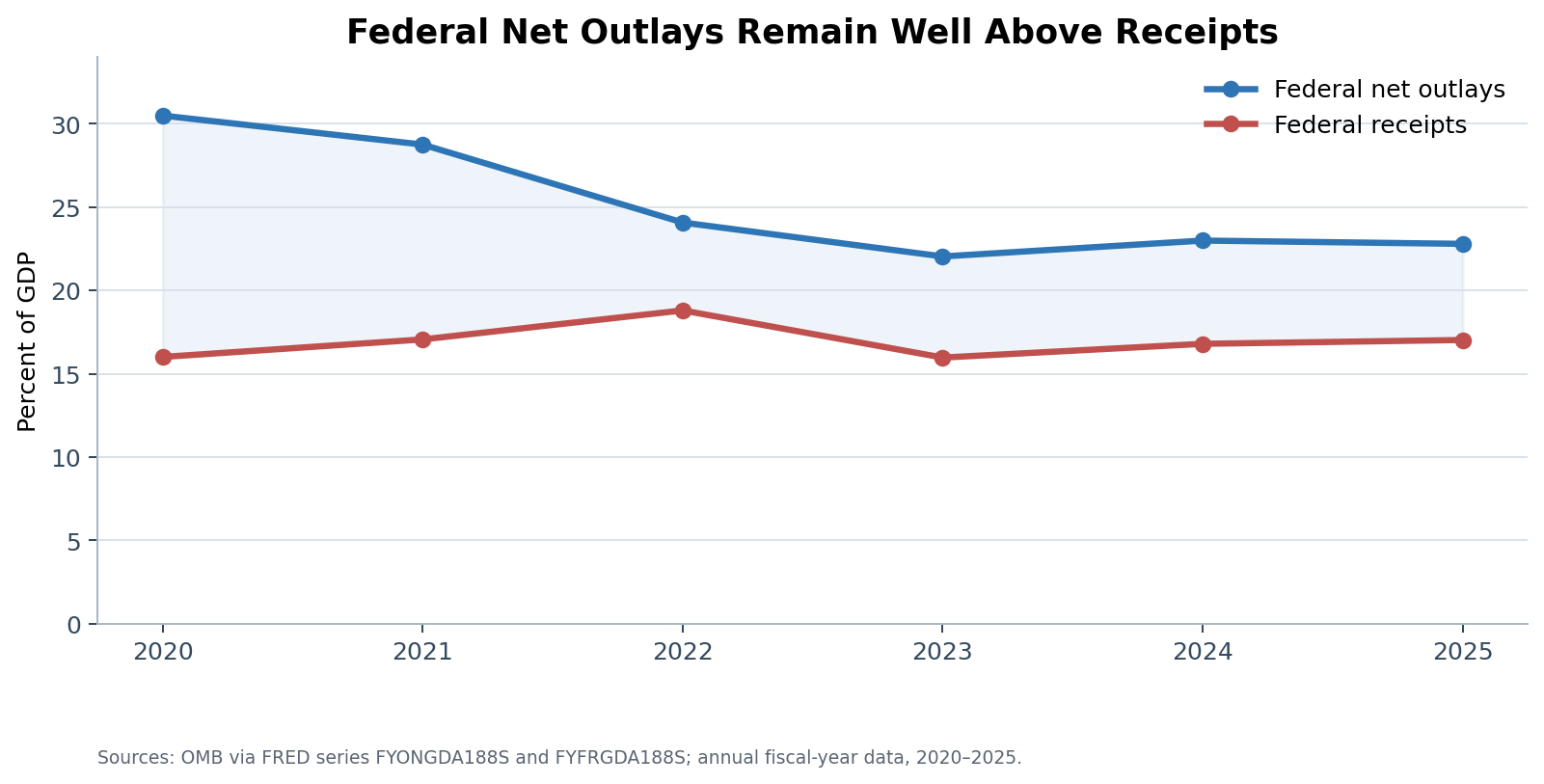
Federal spending is outpacing revenue to an extraordinary degree. Spending is approximately 23% of GDP, well above revenue of about 17% of GDP, as shown in the figure below. That gap is not a temporary accounting discrepancy. It represents a continuing demand for borrowed funds that accumulates into a larger stock of federal debt.
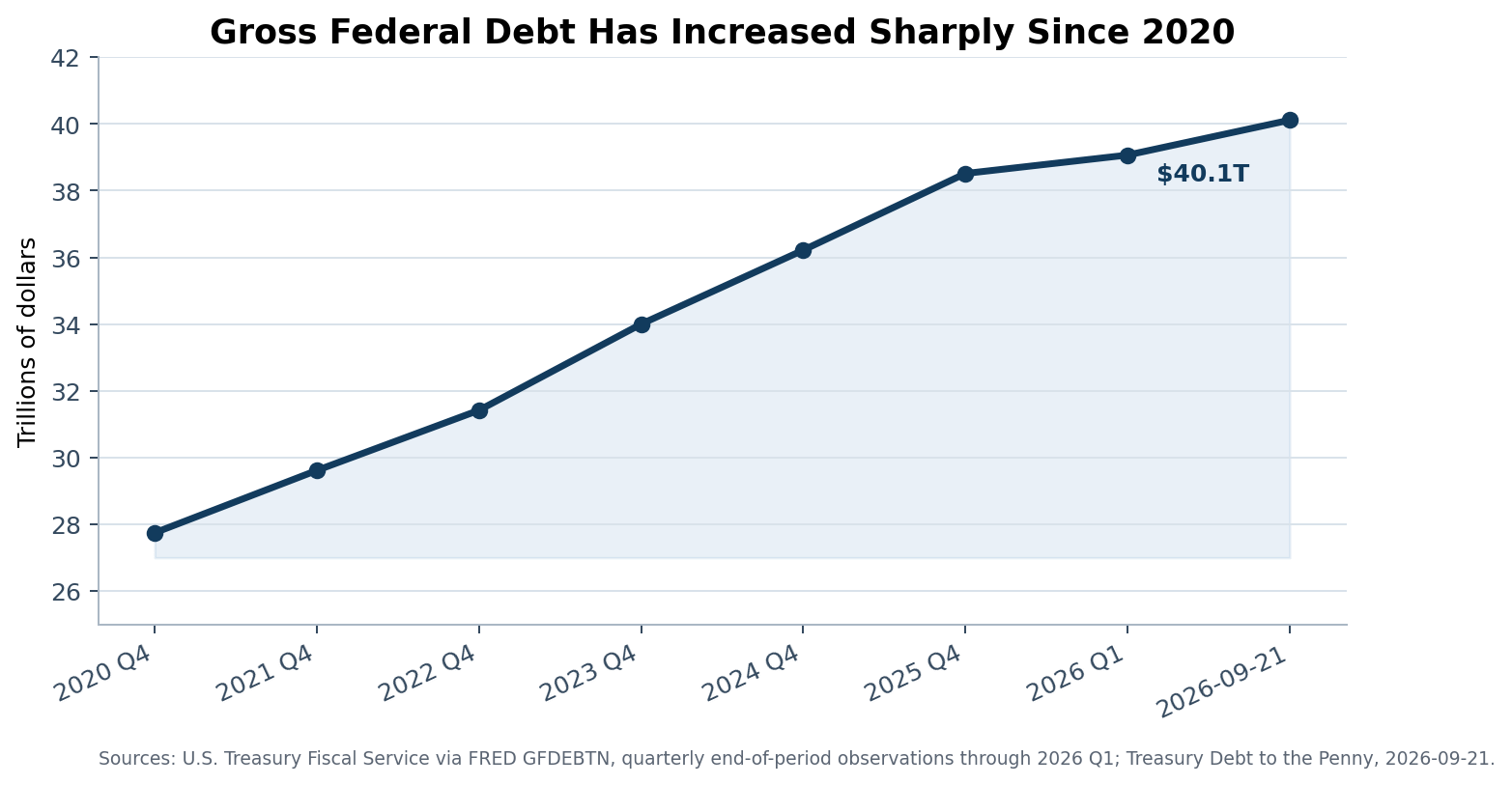
As the next figure shows, federal debt has increased by roughly $12 trillion since 2020, reaching approximately $40 trillion in 2026. Gross federal debt now exceeds 120% of GDP. This debt must be serviced from the same broad pool of savings that finances private borrowing. The larger the government’s claim on that pool, the less readily available capital may be for businesses, households and infrastructure projects.
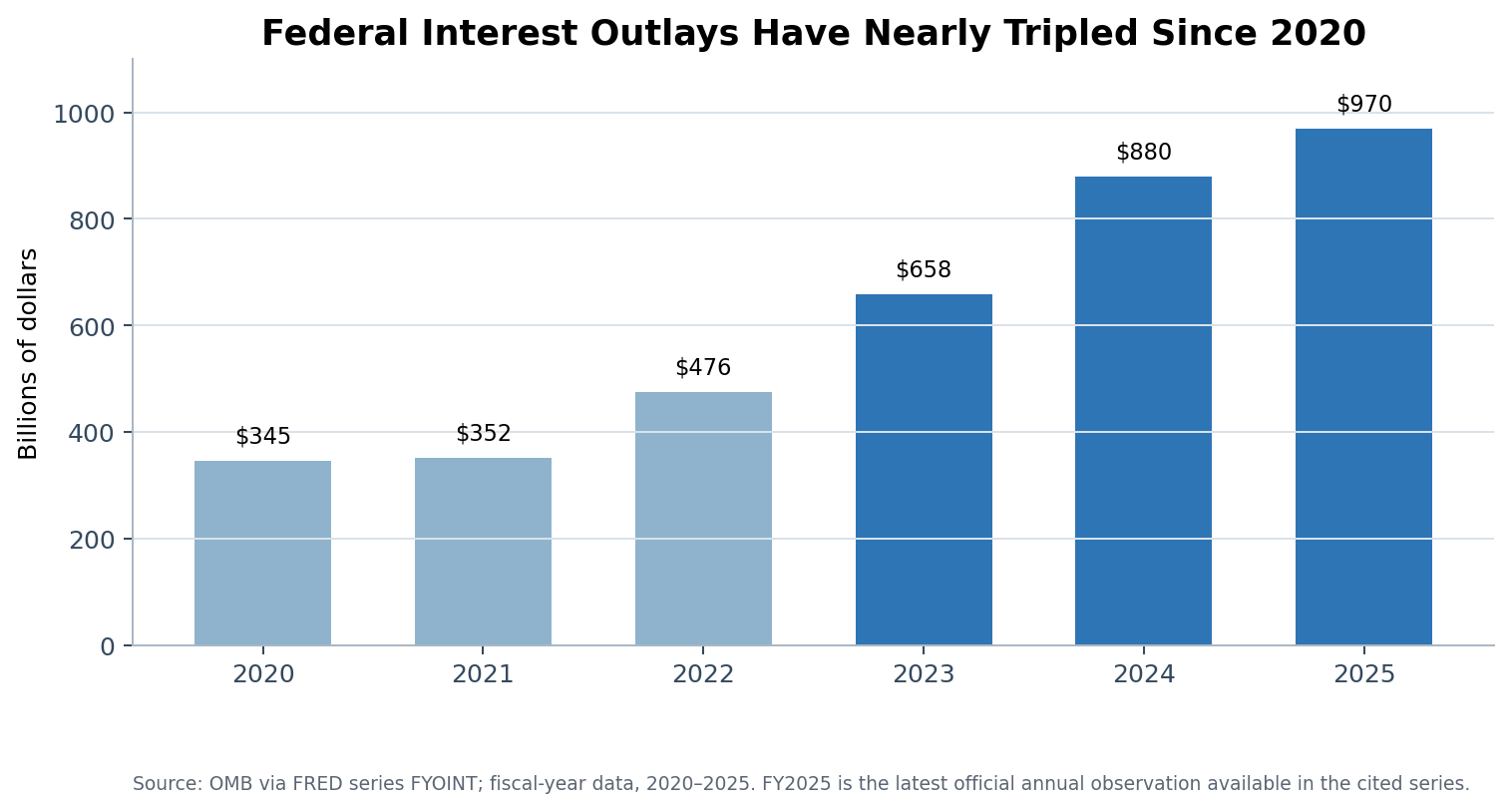
The debt burden is compounded by the cost of servicing it. Net interest costs have roughly tripled since 2020 and now exceed $1 trillion a year, as the next figure illustrates. Higher interest rates raise the cost both of newly issued debt and of refinancing maturing obligations. Interest expense then becomes an additional contributor to the deficit, requiring still more borrowing.
This creates a negative feedback loop. Larger deficits require more Treasury borrowing. More borrowing adds to demand for capital and can place upward pressure on interest rates. Higher rates increase interest expense, which contributes to larger deficits and still more debt. The process can become self-reinforcing even before a conventional debt crisis occurs.
Treasury securities must ultimately be purchased by some combination of foreign investors, domestic private investors, and the Federal Reserve. Foreign buyers, for a variety of economic and geopolitical reasons, have been reducing their relative share of Treasury securities. That shift places more of the financing burden on domestic savers and investors.
As Treasury debt expands, it places upward pressure on domestic interest rates for both the government and the private sector. The effect reaches mortgages, corporate bonds, commercial loans, private credit and infrastructure financing. Credit becomes tighter, and projects that appeared viable when rates were low may no longer produce returns sufficient to justify their financing costs. The ultimate result is lower real output.
Monetary accommodation and its inflationary consequences
Normally, higher rates and slower growth alert voters to government profligacy and create pressure for elected officials to address excess spending. That discipline is weakened, however, if the Federal Reserve extends its mandate beyond price stability and maximum employment and allows itself to become the ultimate source of financing for increased federal spending, as shown in the next figure.
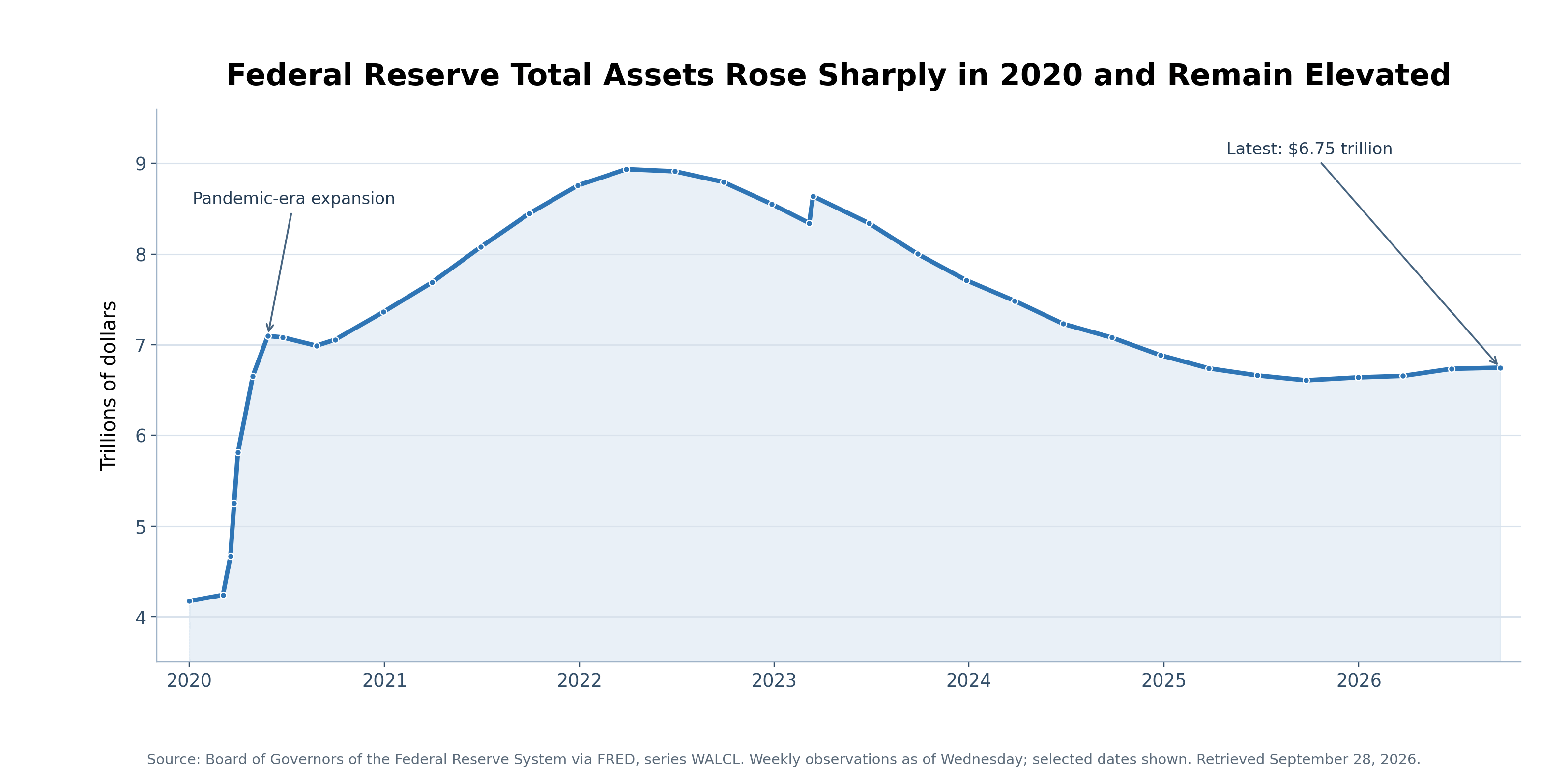
Only the Federal Reserve can create new bank reserves to purchase Treasury debt. In doing so, it can become an enabler of unrestrained federal spending and borrowing. In practical terms, this is what it means to monetize the national debt. Monetization can solve an immediate financing problem by allowing the government to rely less on private savings and keeping interest rates lower than they otherwise would be. But the apparent benefit has a cost. If money and credit expand faster than the economy’s capacity to produce goods and services, the public pays through a regressive inflation tax.
Over the past six years, annual CPI inflation has remained above 3% and reached as high as 9%. Nominal asset values have also risen by roughly 20% to 30% in many markets. The consequences of persistent inflation are broad and damaging. Wealth is redistributed unevenly across income groups, benefiting asset holders while households dependent primarily on wages face higher costs of living before their earnings adjust. Ultimately, persistent inflation can become a source of social unrest.
As a result, the Federal Reserve faces an increasingly difficult choice. It can slow or stop its purchases of excess federal debt, accept the resulting recessionary and financial risks, and attempt to force fiscal authorities to address their spending excesses. Or it can continue to accommodate the Treasury, worsening inflation and creating conditions that eventually produce both financial crisis and recession. Neither course is costless.
Can increased productivity alone solve the debt problem?
Policymakers sometimes suggest that, rather than manage spending or increase taxes, the nation can simply grow its way out of a debt spiral. Faster productivity growth is certainly desirable and can enhance economic growth. But given the extent of the nation’s debt burden, few economists expect productivity increases alone to solve the problem.
Research at the Mercatus Center, for example, has shown that, given current levels of the U.S. primary deficit, even if inflation returned to the 2% target, annual real GDP growth would need to approach 4% and remain there for the primary debt-to-GDP ratio merely to hold steady.
With current annual real growth running between 1.5% and 2%, it is unlikely that productivity improvements alone can solve the nation’s debt problem. Thus, without actions that significantly reduce the size of federal government deficits, the government will remain a major source of demand for scarce capital for decades to come.
AI capital needs add to the crowding pressure
The fiscal problem becomes more consequential when viewed alongside AI developers and their exceptional and sudden demand for capital. AI has moved from being primarily a software story to becoming a capital-markets story. The AI revolution requires advanced semiconductors, data centers, electrical generation, transmission infrastructure, cooling systems, networking equipment, real estate, fiber networks and long-term power contracts. Building this infrastructure will require hundreds of billions—and likely trillions—of dollars in capital, as the table below suggests.
Table 1. Estimated AI infrastructure spending
Year Estimated spending
2025 $426 billion
2026 $779 billion
2027 $1.2 trillion
2028 $1.4 trillion
Source: Morgan Stanley Research, July 2026
The scale of this investment matters because hyperscalers—including Alphabet, Amazon, Meta, Microsoft and SpaceX—expect capital expenditures to exceed operating cash flow in 2026 and beyond. They will therefore demand not only more equity capital but also more debt capital, crowding into the same markets as governments, other businesses and consumers.
When public and private borrowers compete
If the Federal Reserve chooses to slow or cease monetizing the rapidly expanding national debt to preserve price stability, competition for scarce capital will intensify as interest rates rise to rationalize demand. The federal government will fully fund itself regardless of price. AI companies and the hyperscalers supporting them, with their high expected returns, will likely be next in line, leaving other sources of capital demand competing for funds and paying higher prices.
Under these conditions, private firms may have to modify or cancel projects, renegotiate credit arrangements or default because the cost of capital no longer permits them to meet expected returns. That is the essence of crowding out. Unless the combined productivity gains from government and AI investment exceed the productivity of the investments forgone, economic growth will slow. The cost of the government’s excesses will become increasingly apparent and difficult to manage.
Leverage hidden in the AI financing chain
Finally, competition for capital creates incentives for complex and increasingly leveraged financing structures, as demonstrated within the AI sector. For example, companies are entering into forward lease contracts or take-or-pay contracts for information services to be provided by data centers not yet built. These contracts are then often pledged for loans used to build out the centers, with repayment dependent on projected cash flows that have yet to be realized. Vendors, such as chip manufacturers, may also invest in, guarantee or finance a customer’s data-center expansion.
The relationship can become circular: The supplier helps finance the infrastructure; the customer uses the financing to build infrastructure or purchase the supplier’s products; and the customer’s ability to repay depends on projected future AI demand. While such arrangements can be successful, they also increase the industry’s risk profile.
Recent reporting has identified approximately $1 trillion in future lease payments among major technology companies that had not yet begun and, therefore, were not fully reflected as conventional balance-sheet liabilities. The reported commitments include approximately $329 billion for Microsoft, $279 billion for Meta before additional commitments, $260 billion for Oracle, $137 billion for Amazon and $85 billion for Alphabet. These are estimates, but they illustrate the uncertainty surrounding future stability because they assume that demand for AI services and prices will continue to increase uninterrupted.
It’s time for a capital demand strategy
The United States is attempting to finance historic increases in the demand for capital. The federal government is conducting an unprecedented expansion of the nation’s debt; private AI companies are developing new technologies that require a massive private investment program; and an increasingly complex U.S. economy requires significant capital to remain globally competitive. There is also less certainty about the global supply of capital at a time when the government’s demands are accelerating and appear to be crowding out private investors.
If these developments continue, they will place long-run economic growth at risk. The time to address this conflict is before financial stress forces a crisis. The country needs a credible fiscal strategy that rebalances the demand for capital between government and private uses of national resources. Without such a strategy, the economy will become less productive and more financially fragile.
Principal sources
· Federal Reserve H.15 Treasury interest-rate data
· Office of Management and Budget, Historical Tables
· Congressional Budget Office, The Long-Term Budget Outlook: 2025 to 2055
· Congressional Budget Office, The Budget and Economic Outlook: 2025 to 2035
· Federal Reserve Bank of St. Louis, FRED series
· Bureau of Economic Analysis, Personal Consumption Expenditures Price Index
· Jack Salmon, Mercatus Center, Public Debt and Economic Growth in the United States, July 7, 2026
· Financial Times, “The hyperscalers’ exploding purchase commitments reach $1.5tn”
· Morgan Stanley Research, July 12, 2026,Brian Nowack, CFA