
Federal Reserve Chairman Kevin Warsh’s remarks at the Jackson Hole Economic Policy Symposium were widely interpreted as a hawkish speech. Financial markets responded by increasing the odds of a quarter-point increase in the federal funds rate at the Federal Open Market Committee’s September meeting. Interest-rate futures placed the probability of a September increase near 58 percent, compared with roughly 35 percent before the speech, while short-term Treasury yields increased. The Wall Street Journal summarized the market reaction in a straightforward headline: “Warsh Comments Boost Rate-Hike Bets.” (The Wall Street Journal)
That interpretation is understandable. Warsh emphasized that inflation remains too high, that the Federal Reserve is responsible for bringing it down, and that recent data do not yet demonstrate meaningful improvement in underlying inflation. Yet the market may be getting ahead of itself if the speech is taken as a commitment to raise rates in September. Its central message was not a decision, but a disciplined framework for making decisions as information becomes available.
While such a framework is commendable, the real test of Warsh’s speech and policy framework—and of his and the FOMC’s credibility—will come at the September and following meetings, when whatever decision the Committee makes must be explained clearly, fully, and convincingly.
A Rejection of Forward Guidance
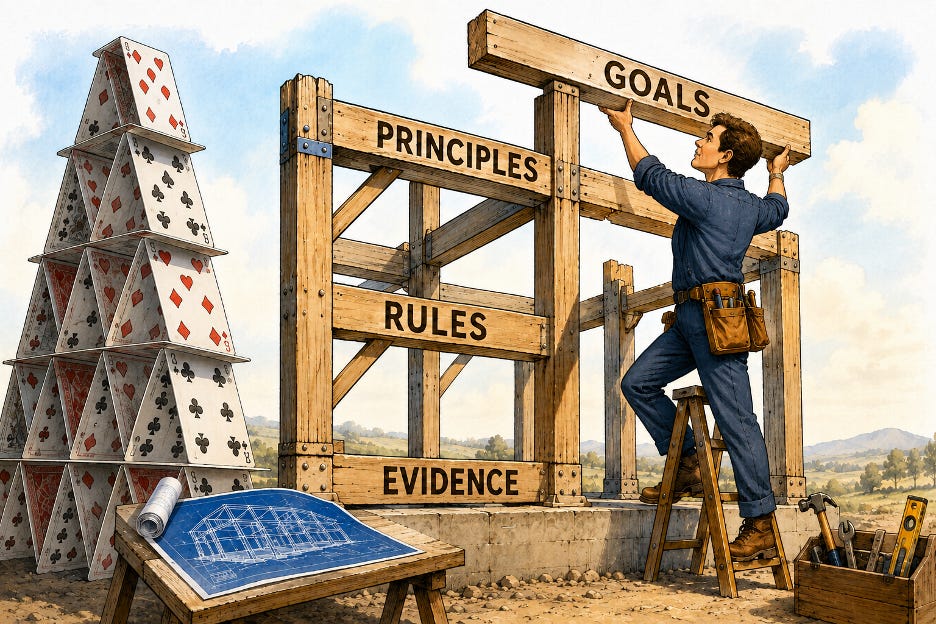
The most important feature of the speech was Warsh’s continued rejection of conventional forward guidance. He made clear that he does not intend to signal in advance the specific policy actions the FOMC may take at future meetings. He made a strong case arguing that forward guidance can create the appearance of clarity while actually causing confusion. When the Fed makes quasi-commitments about the future path of interest rates, markets, businesses, and households tend to organize their decisions around those commitments. If economic conditions then change, the central bank may feel pressure to follow through on earlier statements even though doing so may no longer be appropriate.
In Warsh’s words, excessive guidance can “inhibit our own freedom to make the right calls when it’s time to decide.” He went on to say that “I stand here today committed to a discipline, not to a decision.”
Having provided his framework, Warsh went on to provide his analysis of the Economic and inflation outlook.
Warsh’s Economic Outlook
Warsh offered a bullish assessment of the economy. He described both Main Street and Wall Street as resilient and pointed to strong business investment, corporate profits, credit conditions, consumer spending, and labor markets.
He made clear that the strength in economic activity is important because it gives the Federal Reserve room to focus more directly on the price-stability side of its mandate. The economy, in Warsh’s assessment, is not showing the broad weakness that would force the Fed to subordinate inflation concerns to an urgent need to support employment.
Inflation, therefore, was the central concern of the speech.
Warsh’s Inflation Analysis
Warsh was unequivocal that the Fed’s 2 percent inflation objective, measured by the personal consumption expenditures price index, is a “firm, fixed target.” Price stability is not automatic, he argued, and inflation should not be assumed to return to 2 percent on its own. It is the Federal Reserve’s responsibility to deliver stable prices.
He also acknowledged that the current inflation data remain troubling. Twelve-month PCE inflation stood at 3.7 percent, while the six-month annualized rate was 4.1 percent. Comparable measures of consumer price inflation, including core measures, were also elevated and that recent progress in bringing inflation down to the target was modest and that little improvement had been achieved in the underlying inflation trend.
It was also important that while he noted that inflation expectations were stable and well anchored, he was quick to caution that expectations can appear durable until they suddenly become unmoored.
His conclusion was direct and noteworthy: The Fed must be confident that underlying inflation is moving toward 2 percent “clearly and at sufficient speed.” If it is not, “we have work to do.”
Why the Speech Was Viewed as Hawkish
These remarks explain the market’s reaction. Warsh placed inflation above other immediate concerns and made clear that rate increases remain possible. He also stated that the economy and financial conditions did not appear sufficiently weak to require additional monetary support.
The Associated Press reported that Warsh’s remarks suggested inflation was broad and not simply the result of higher gasoline prices associated with the war involving Iran or one-time tariff effects. (Associated Press)
Financial markets interpreted these comments as evidence that the FOMC may need to raise rates in September. Short-term Treasury yields rose, the dollar strengthened, and interest-rate futures increased the probability of a quarter-point rate increase. The Financial Times reported that futures markets were assigning approximately a 57 percent probability to a September increase.
Such an interpretation is understandable. If inflation remains above target, if its breadth remains excessive, and if financial conditions are not restrictive, a further rate increase would be consistent with Warsh’s stated framework.
Did the Media Get Ahead of Itself?
But there is more to the speech that should not be overlooked that says, September actions won’t be decided till September.
Warsh’s emphasis on trends is critical. Inflation is above target, but the relevant question is not only its current level. The Fed must determine whether inflation is rising, falling, or stuck—and how rapidly that direction is changing.
The speech used the phrase “second derivative”. That is not a layman’s term, and I am confident its use had a purpose. Warsh used it when discussing changes in the growth rates of capital spending and corporate earnings. But the broader concept applies to his inflation analysis. The first question is whether inflation is moving up or down. The second is whether the rate of change itself is accelerating or slowing.
A slowing rate of inflation is not the same as low inflation. But it may indicate that the forces driving inflation are weakening. If the next inflation report shows that the rate of increase is slowing further, the FOMC could conclude that interest rates along the yield curve, including the policy rate, is slowing inflation and decide not to raise rates in September.
There are also other important uncertainties affecting the inflation outlook. Some price pressures may reflect tariffs or energy-related effects associated with the war involving Iran. Whether those effects prove temporary or become embedded in broader inflation expectations matter. If tariffs raise prices once but do not generate continuing inflation, the appropriate policy response may differ from the response required if those increases spread through wages, services, and expectations.
The September decision may yet depend on a flow of information: the next inflation report, employment data, consumer demand, financial conditions, commodity prices, and developments in supply chains and geopolitics. (Financial Times)
This is precisely why Warsh rejects forward guidance. A central bank that announces its future policy path in advance risks becoming captive to that announcement. A central bank that remains committed to a disciplined framework can respond to the data as circumstances evolve.
Markets Must Draw Their Own Conclusions
By reducing forward guidance, Warsh is requiring market participants to do more of their own analytical work. Investors cannot simply wait for the Chairman to reveal the next policy action. They must assess the economy, inflation, employment, and financial conditions and then form their own expectations.
That approach will inevitably produce uncertainty. Markets will draw conclusions from Warsh’s language, but those conclusions may change as new data arrive. The immediate market reaction suggests that investors interpreted the speech as making a September rate increase more likely. But market pricing is an expectation, not a decision.
Only time—and the FOMC’s September meeting—will tell us what action the Committee takes.
The Real Test of the Chairman Warsh and the FOMC’s Credibility
The real test will then begin. Whatever decision the FOMC makes, the Chairman and the FOMC must explain their reasoning fully and convincingly. If rates are increased, the Fed must explain why inflation is not moderating sufficiently, why additional restraint is necessary, and how the decision supports both sides of the dual mandate.
If rates are left unchanged, the Fed must explain what evidence indicates that inflation is slowing, why patience is appropriate.
The explanation must be forthright, detailed, and grounded in economic analysis. It must be clear enough for markets and the public to understand—and credible enough to demonstrate that the action was based on the Fed’s mandate rather than political pressure and related considerations, which are always present.
Warsh has emphasized accountability for achieving price stability and maximum employment. Accountability requires more than a framework, more than announcing a policy decision. It requires explaining the evidence, the risks, and the reasoning behind that decision.
Warsh’s Jackson Hole speech is, therefore, best understood as a declaration of method. He committed the Fed to price stability, maximum employment, careful attention to economic trends, and a willingness to act when necessary. But he did not commit to a policy path or reaction function.
The speech was hawkish. It made clear that inflation remains unacceptable. Its further message, however, was that monetary policy is not decided till meeting day. A September rate increase is possible, but it is not predetermined. The next inflation report and the broader economic evidence will determine whether the FOMC concludes that more restraint is needed—or what moderation in inflation is sufficiently convincing to justify holding rates steady. Finally, and most importantly, the credibility of this new framework will ultimately depend on whether the September decision, whatever it may be, is explained with the clarity and rigor that the framework requires.
It seems like the Fed is coming to a consensus that r-star is not close to 3% (as the long-range forecast for the Fed Funds rate would suggest) but is closer to 3.5% - 4%.
There has been quite a few comments that policy is not restrictive, while a 3.1% estimate for r-star suggests it is.