
Thomas Hoenig and Geert Ensing
Why did one bank’s failure trigger a systemic crisis?
The Federal Reserve’s initial postmortem report on the 2023 failure of Silicon Valley Bank (SVB) identified serious weaknesses in both management and supervisory oversight. Careless portfolio management, insufficient hedging discipline, and poor capital and liquidity management made the bank vulnerable to a fast-moving depositor run that caused it to fail. The bank’s supervisors also failed to address its weaknesses.
Those mistakes explain this single failure. But they don’t explain why its collapse triggered a broader banking crisis.
The crisis that followed SVB’s collapse was about more than one mismanaged bank. Government policies had encouraged banks across the industry to take similar risks, leaving many vulnerable when interest rates rose.
Four policy incentives were particularly significant in encouraging banks to take on duration risk — the risk that their assets would lose value as interest rates rose.
First, creditor protection. The government’s history of protecting creditors, including uninsured depositors, when financial institutions failed, which created a classic moral hazard problem: expected protection weakened incentives to guard against loss.
Second, capital rules. Capital requirements did not increase as the maturity of Treasury holdings increased.
Third, regulatory compliance. Inadequate risk metrics and an emphasis on regulatory processes created an environment in which regulatory technical compliance displaced traditional risk management.
Fourth, monetary policy. The Federal Reserve provided guidance regarding future policy during extended periods of low rates. The effect was to make greater duration exposure appear a reliable “carry” strategy: earning the spread between longer-term asset yields and short-term funding costs.
SVB failed, but the incentives that led to its failure affected more than this one bank — making its failure an information shock that triggered a broader loss of confidence in the industry. When the extent of creditor protection became uncertain, depositors ran not only from SVB, but from perceived peers. The SVB failure is a lesson that should remind policymakers of how well-intended short-term policies can undermine industry-wide prudent risk management. Thus, the postmortem of the events around SVB’s failure should include its transition into a systemic crisis.
Moral hazard: how repeated creditor protection changes the risk calculus
Over decades, banks and depositors came to expect that government protection could extend beyond insured deposits. The precedents include the protection of all creditors at Continental Illinois in 1984 and unlimited coverage for eligible transaction accounts introduced in 2008. An FDIC review found that uninsured depositors incurred losses in only 6% of bank failures from 2008 through 2022; often an acquiring bank assumed all deposits.
This history reinforced expectations of protection beyond the statutory insurance limit.
That repeated experience shapes expectations. It does not require decision-makers to believe “we will be bailed out.” Instead, it changes how banks and depositors assess the possibility of severe losses. Over time, that expectation can reduce banks’ incentives to structure portfolios defensively against extreme outcomes.
These moral hazard effects work through two channels.
First, creditor protection can encourage banks to take greater risks. If bank managers believe that government intervention — through liquidity support or resolution mechanisms —will limit losses for large creditors, risky balance-sheet strategies become less costly to fund. Banks may therefore rationally take on more risk, such as greater duration mismatch, because expected creditor protection makes that risk cheaper to fund. Farhi and Tirole show how expected intervention can encourage banks to adopt similar maturity mismatches, making the resulting fragility systemic.
Second, expectations of government protection influence whether depositors withdraw their money. When depositors and creditors believe that rescue will be quick and comprehensive, they are less likely to run. But when rescue becomes uncertain, the incentive to withdraw before others can intensify rapidly.
When SVB failed on March 10, 2023, the FDIC took control of the bank and initially announced that uninsured depositors would receive an advance dividend and claims on the remaining receivership proceeds. The bank had been closed, but the timing and extent of recovery for its uninsured depositors remained uncertain.
Moral hazard is not only about banks taking more risk. It is also about depositors and other creditors taking less care. If market participants expect the state to step in, their incentive to act on early warning signs declines. Deposit flows can become slower to react until confidence collapses.
SVB’s failure and the FDIC’s delay in protecting its uninsured depositors triggered depositor runs at banks across the industry. Subsequently, on March 12, authorities declared a systemic risk crisis and full depositor protection at SVB and Signature Bank, including uninsured deposits.
Establishing expectations of depositor protection and applying them inconsistently is a formula for crisis.
Capital rules: how risk-weighting can encourage duration mismatch
Under standardized risk-based capital rules, banks are not required to hold more risk-based capital simply because their Treasury securities are more sensitive to interest-rate changes. A long-duration Treasury receives the same zero percent risk weight as a short-duration bill. Leverage requirements still apply, but they also do not distinguish between maturities.
This capital treatment encourages banks to seek additional yield by extending maturity without a corresponding increase in risk-based capital. SVB’s exposure also included a large portfolio of agency mortgage-backed securities, whose credit protection did not prevent market losses when rates rose. As interest rates rose rapidly, valuation losses created liquidity stress as depositors lost confidence in the solvency of SVB and then of other banks.
Accounting rules can also obscure losses from rising interest rates. Held-to-maturity securities remain at amortized cost rather than current market value, so interest rate losses do not reduce reported equity or regulatory capital. Available-for-sale securities are marked to market, with unrealized interest rate losses reducing accounting equity. But banks permitted to elect the AOCI opt-out, including SVB, can exclude those losses from regulatory capital.
A bank may therefore appear adequately capitalized under regulatory rules even as market losses erode the protection available to depositors. When liquidity pressures force sales, those losses can rapidly impair capital and intensify a run.
From an incentive perspective, the gap between regulatory measures and actual losses can reduce the perceived “cost of being wrong.” When regulatory capital appears adequate even as the balance sheet’s economic value is eroding, then both internal governance and supervisory reassurance can fail to trigger timely corrective action. Even when specialists recognize the problem, the system needs enforceable constraints that compel risk reduction.
As interest rates increased, SVB and much of the industry incurred high levels of unrealized losses. On March 8, 2023, SVB announced a $21 billion securities sale and a $1.8 billion after-tax loss. As uncertainty grew over whether uninsured deposits would be repaid, creditors sought safety not only from SVB but also from banks with similar risk profiles.
Compliance versus risk management
Moral hazard and incomplete risk metrics reinforce one another. When creditors expect government protection and capital ratios fail to distinguish between different levels of interest rate risk, regulators may find it harder to challenge banks that appear to comply with the rules. Bank managers can defend a strategy by pointing to acceptable regulatory ratios, while supervisors may mistake those ratios for evidence of resilience.
Risk management becomes an exercise in satisfying the measure rather than controlling the exposure.
SVB illustrates the result. The Fed’s review found that its internal materials emphasized compliance with regulatory standards and responses to supervisory findings rather than management of actual risks. In April 2022, SVB changed its assumptions about how long deposits would remain at the bank, effectively treating deposits as longer-term funding. The change made the measured mismatch appear smaller without removing risk from the balance sheet. Later that year, changes to liquidity assumptions made the bank’s funding needs appear smaller without resolving the underlying shortfall.
Supervisory practice reinforced the problem. Examiners identified interest rate risk deficiencies in the 2020, 2021, and 2022 examinations, but a formal supervisory finding did not follow until November 2022. The bank failed before the planned downgrade of its interest rate risk rating was finalized. Recognizing a weakness and requiring another corrective plan did not ensure that the exposure was reduced.
The connection to moral hazard is institutional. Compliance creates a ready defense for a bank when losses emerge: The bank followed official capital rules and held officially favored assets. If many banks adopt the same strategy, their common vulnerability increases the pressure for government intervention. Farhi and Tirole’s analysis explains why anticipated support can make correlated risk-taking privately attractive. Regulatory compliance can then become both a substitute for independent judgment before a crisis and an argument for public protection after it. Supervisors must judge whether a bank can withstand adverse conditions and compel corrective action when it cannot.
Monetary policy incentives: how low interest rates encouraged risk taking
Macroeconomic policy also contributed to the banking panic surrounding SVB’s failure. Since the early 2000s, the Federal Reserve had used forward guidance — public statements about the likely direction of future interest rates — as a prominent feature of monetary policy. In August 2003, for example, the FOMC said that “policy accommodation can be maintained for a considerable period.” This messaging became common practice in guiding markets as to the FOMC’s policy outlook. On June 10, 2020, Chair Powell said the Fed was “not even thinking about thinking about raising rates.”
From March 2020 through the end of 2021, the Federal Reserve purchased large quantities of Treasuries and agency mortgage-backed securities, reinforcing expectations of continued low rates. In March 2021, FOMC participants’ median projected federal funds rate was 0.1 percent in every year through 2023. These policies and communications encouraged banks to treat cheap short-term funding as durable, making greater duration exposure appear attractive.
As the chart below illustrates, years of low interest rates and guidance about future policy were followed by a sharp reversal as the Fed raised rates in 2022 and 2023.

When inflation rose and the Fed rapidly raised interest rates in 2022, the yield curve repriced quickly. As the second chart, below, illustrates, the sharp rise in interest rates during 2022 and 2023 substantially exceeded what markets had expected a year earlier. Banks holding long-duration portfolios experienced large market value declines. Unrealized losses on securities across FDIC-insured banks exceeded $600 billion at year-end 2022. The accounting and capital rules kept many of these losses out of regulatory capital, allowing banks to appear well capitalized although the economic losses remained.
For banks with vulnerable funding, the problem was straightforward: If their assets had lost value, could they withstand the combined liquidity and valuation shock without needing to sell at a loss? For banks funded by uninsured and unstable deposits, liquidity stress became immediate when depositors questioned their safety. Such uncertainty becomes a motive to take flight, as happened with SVB initially, spreading rapidly to banks with similar profiles.
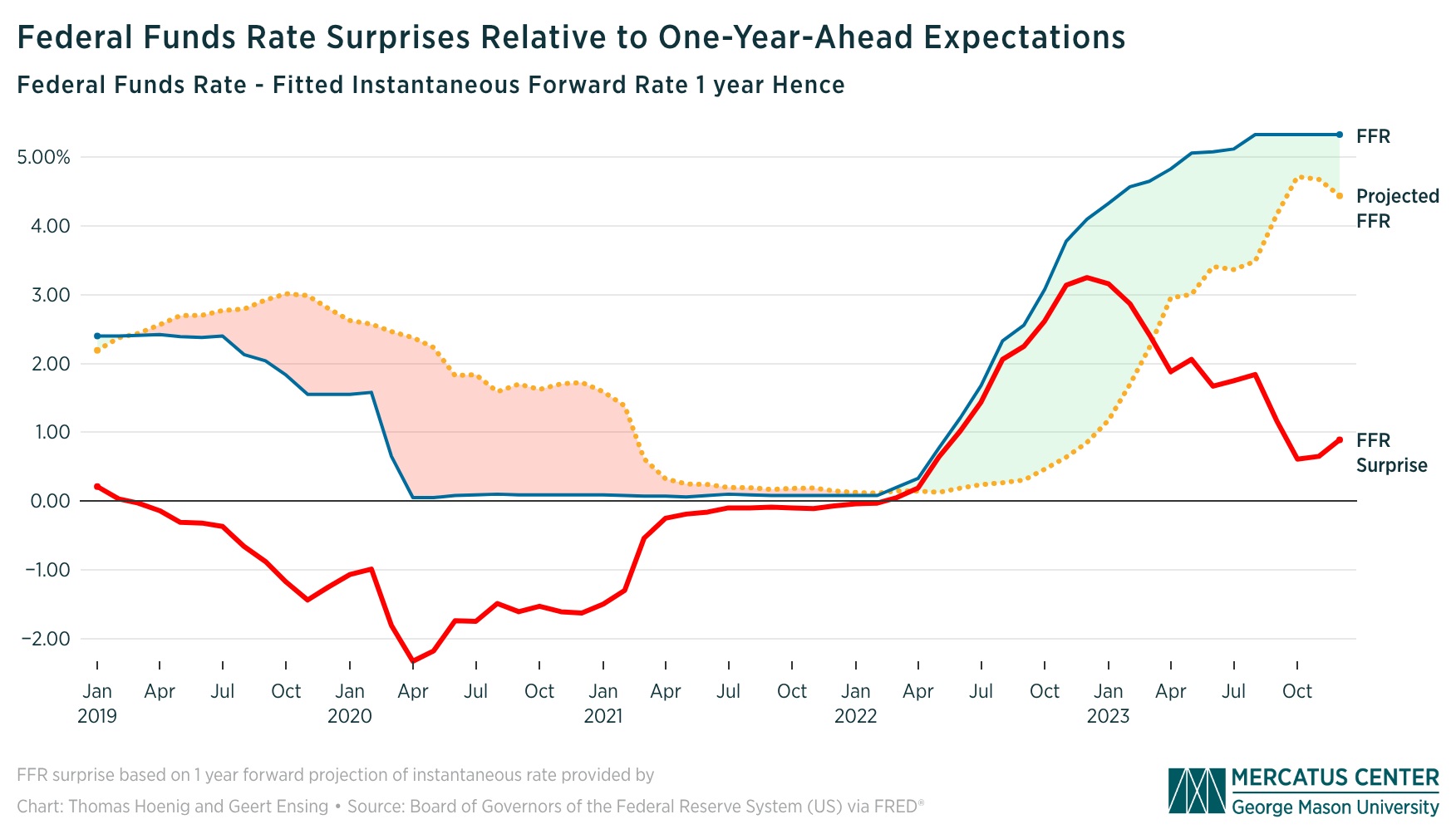
Monetary policy did not by itself cause the run. A concentration of uninsured deposits, insufficient hedging, liquidity mismatch, and management failure made SVB vulnerable. But monetary policy created the macroeconomic environment and shaped expectations that made unsound duration strategies appear attractive. When rates rose, those shared exposures turned a bank-specific failure into a broader threat to financial stability.
Conclusion
SVB’s collapse was driven by identifiable bank-specific mistakes and supervisory weaknesses. Yet its failure became a catalyst for a broader banking panic.
Decades of supervisory and monetary policy choices built a fragile equilibrium within the industry: Banks held duration-heavy assets, regulatory metrics suggested the banks were adequately capitalized, and expectations of creditor protection weakened incentives to challenge the risks. In such a world, the equilibrium could appear stable until an event like SVB’s collapse exposed those shared vulnerabilities.
Policymakers should therefore look beyond the management and examiner errors responsible for SVB’s failure and examine the monetary and supervisory policy incentives that helped turn one bank’s collapse into a systemic crisis.