
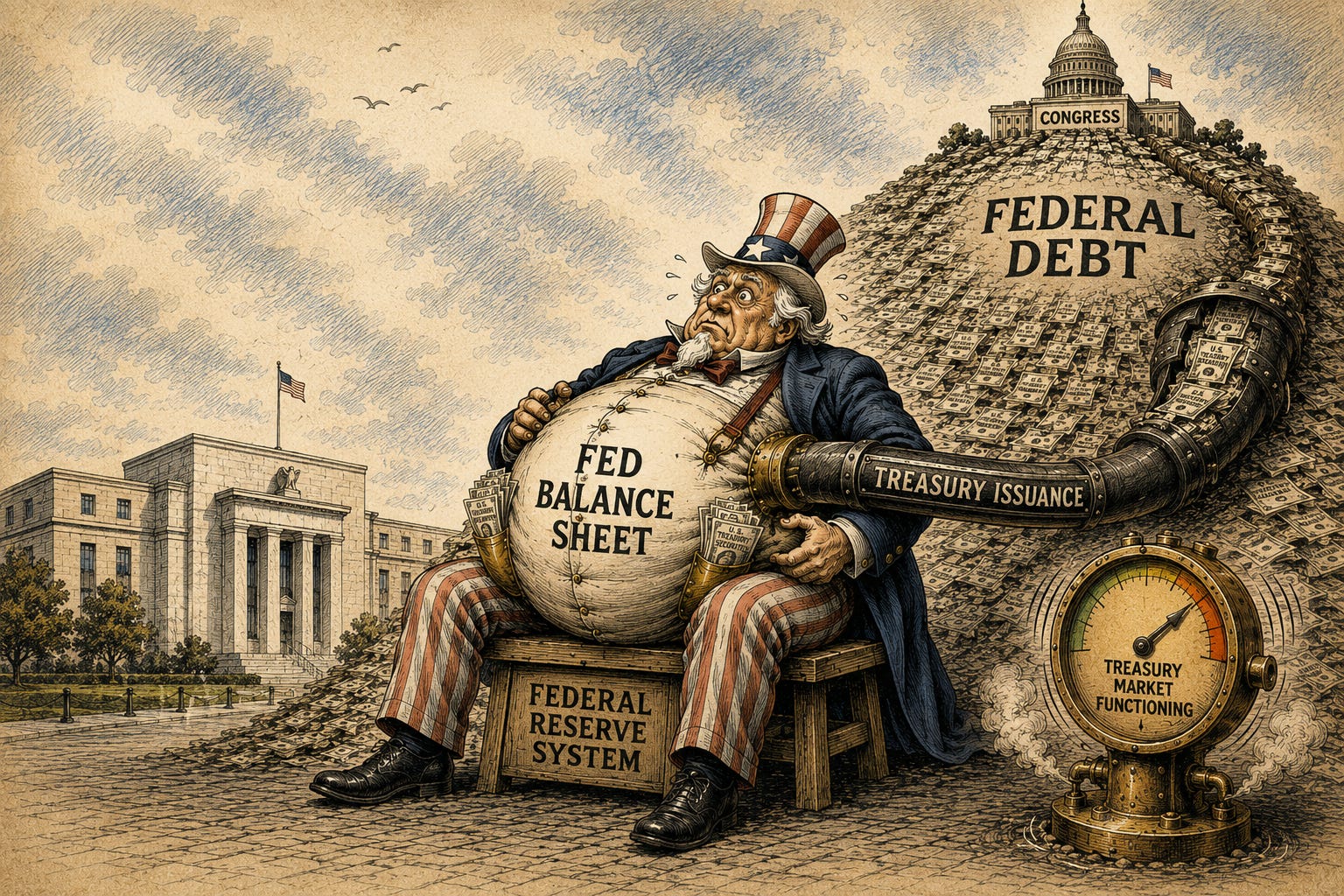
The Fed’s large balance sheet is not the problem but a symptom of the problem.
The problem is that the U.S. fiscal authority is running annual deficits of $2 trillion.
The problem is that the Federal Reserve System has allowed itself to become subservient to fiscal policy and has adopted an implicit mandate to keep the Treasury market “smoothly functioning” and highly liquid.
So long as this mandate dominates policy, the Fed’s balance sheet must grow and/or the rules regarding bank capital and liquidity must be eased to allow the private sector to hold more Treasury debt.
It is no coincidence that, since December 2025, the Fed’s net holdings of U.S. securities have increased $200 billion, approaching a total of $4.5 trillion, and that bank regulators are easing the rules governing both capital and liquidity.
If the Fed and regulators don’t accommodate Treasury debt growth, interest rates will rise until something breaks. If they continue to accommodate Treasury debt growth, interest rates will be subdued until inflation forces everyone’s hand.
Only Congress can solve the problem.
Or for real economists in America, the implicit public policy has been that Dem Presidents can't pass any programs unless they are totally paid for (no matter how it improves the U.S. economy and quality of life) from Federal spending cuts of equal size; but when every incompetent (except Bush 41) GOP President comes in, they spend like drunken sailors (as well as undoing every Dem President's achievements). Secondly, the Federal Reserve monetary policy has dominated fiscal policy for decades because the GOP will no longer vote for new fiscal spending (only cuts for folks who pay taxes) to pull us out of recessions, even spending for most basic, win-win spending (crumbling infrastructure including electrical grids, IRS audits, deep sea oil platform or food inspection, FEMA, CDC, toxic waste dump cleanup, food stamps). But GOP themselves crippled the Fed by meddling with their "independence," pressuring against interest rate hikes when (as now) inflationary expectations may return U.S. to stagflation of 50 years ago (inflation so economically painful to squeeze out).
Great graphic! "...the Federal Reserve System has allowed itself to become subservient to fiscal policy..." Allowed? It seems that America's democratically elected 'spendthrift' Congress gave the FED an impossible mandate (mission): maximum employment and stable prices, despite the FED's toolbox of creative monetary policies. What would a reasonable short-term and/or long-term alternative course have looked like?